Between Two Sounds
Another lesson in slowing down and being still, this time from Arvo Pärt
Over the last few years, one of my big life lessons seems to have been ‘slow down’. My former Chief Exec regularly reminded me that “you have more time than you think”. A leadership course I took a few years ago introduced me to Michael Bungay Stanier (MBS) and his exhortation to “stay curious for longer”. Some one to one coaching with the lovely and excellent Alison Reid, who (rightly) describes herself as a ‘catalyst for calm and confidence’, means I have a scheduled-in-my-calendar 11am breathing check-in as part of my day; a moment to pause, recalibrate and find calm. Last year a wholesome midlife crisis led me to join a gym, one which fundamentally values holistic wellbeing and which, as a result, incorporates a range of treatments and activities alongside strength classes. And I’m lucky enough to do a job where, however stressful it’s been, I get to walk into a concert hall, leave everything behind and immerse myself in music.
In grappling with that lesson (still very much a work in progress), it seems to me that often, silence goes hand in hand with slowing down. The example my former Chief Exec often used when talking about time was how his Dad used to take off and clean his glasses when he was gearing up to respond to something - a simple action, completed in silence, which gave him space to formulate his thoughts. There’s an episode of Brené Brown’s podcast ‘Dare to Lead’ where MBS leads her through his coaching practice and the silences that fall as he invites her to really reflect on issues and challenges hang so long that you’d swear the podcast had somehow paused itself (as an aside, Brené Brown is a total queen in her own right and well worth investigating. Her Netflix special ‘The Call To Courage’ is a good place to start). The coaching with Alison Reid introduced me to preparing for the day not by making to do lists or reading emails, but by taking five minutes for silent breath work, and my 11am reminder is designed to take me back to that place of stillness and calm. At my gym, not only do I now force myself to lift weights on a thrice-weekly basis, but yoga has become a really important part of my weekly routine, thanks to a brilliant class as part of my membership, and one where I value enormously time on the mat, working with my body in silence. As for music? A recent trip to Estonia with Aileen, one of my best mates, was a really special insight into why silence matters there too.
Thanks for reading What Happens with Music! Subscribe for free to receive new posts and support my work.
Our trip was already proving an exercise in slowing down. We’d flown to Helsinki and then took the ferry across the Gulf of Finland to Tallinn, and had genuinely discussed how ferry travel instantly alters the pace set for a holiday, as we sat outside on deck in balmy sunshine enjoying our new favourite beverage, Long Drink. The driving purpose behind the holiday was specifically to travel to Laulasmaa, about an hour outside Tallinn to visit the Arvo Pärt Centre, a living archive-cum-library-cum-exhibition space-cum venue centred around the continuing life and work of Estonia’s great composer, still alive and heading for 90.
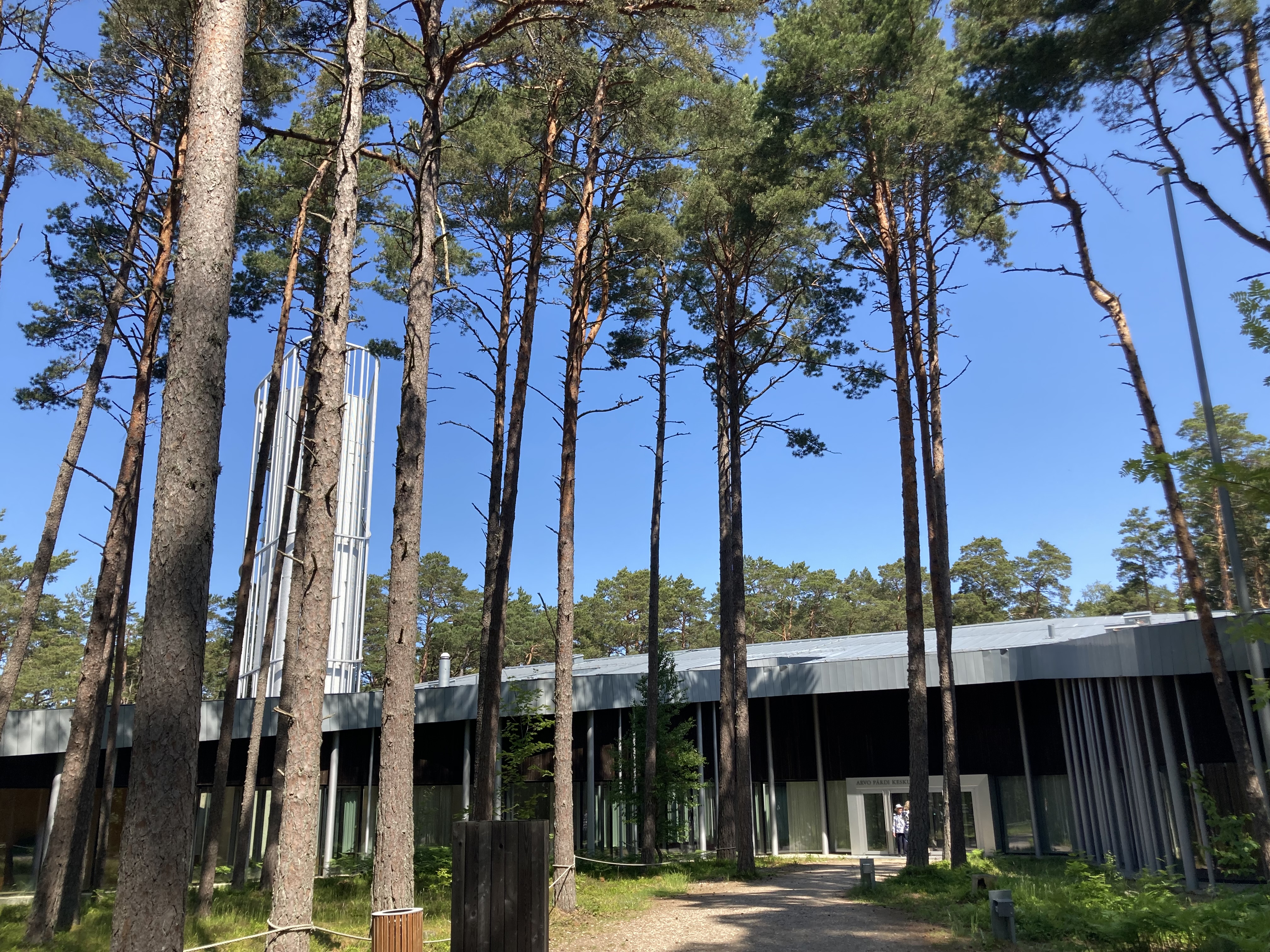
The sky was cloudless and the sun out as we got off the bus on a dusty road, near what looked like not very much in particular. A sign led us down a road with no footpath before we were directed into a birch forest. We were in the Baltics, of course it was a birch forest; it’s the most ‘of that place’ setting you could possibly imagine. We had arrived a little before the centre opened for the day so sat on a bench in the forest, listening to the sounds of nature and watching a bird fly in and out of a nest box feeding its young, before we headed to the centre; a low, single-storey building with a tower that rises above the tree canopy and which emerged quietly into view as we walked through the trees. It’s quite an arrival.
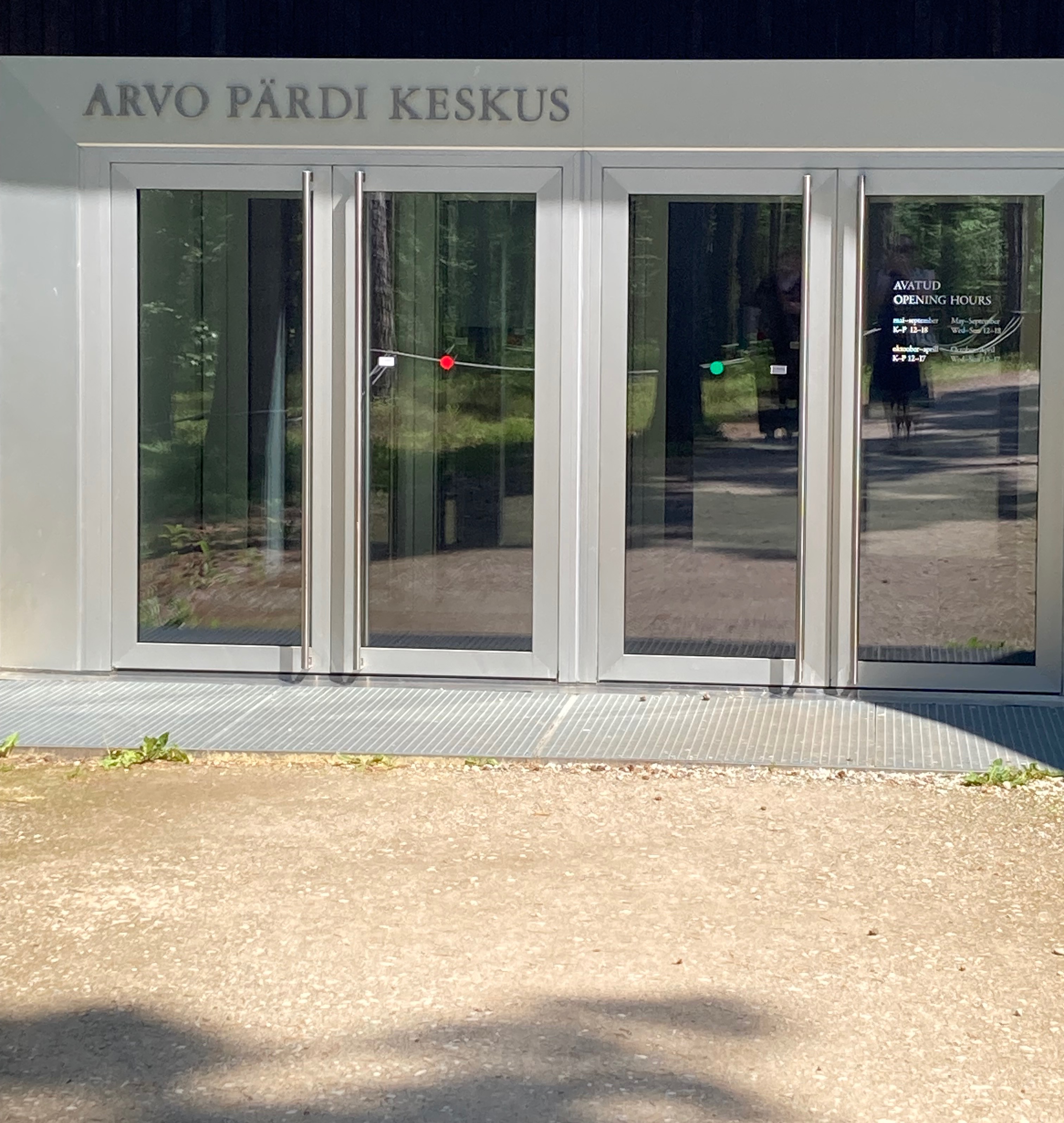
After coffee and a pistachio bun* in the excellent cafe, we watched a fascinating documentary about Pärt’s life and I realised that I had no idea that - much like Shostakovich, another composer I’m fascinated by - he was under so much pressure from the state to write the ‘right’ sort of music and move away from the very explicit religious aspect of his writing that he and his family eventually fled Estonia in 1980. That’s so recent. In 1980 I was already watching Top of the Pops, had started primary school and had a new little brother.
Afterwards, it was on with the headphones for the guided tour round the building. And despite this wonderful, calm arrival and introduction, I found myself wishing that the tour guide would speed up the narrative a bit, only to almost immediately be gently chastised by the same narrative, which invited me to slow down and embrace my surroundings and Pärt’s ideas. Oops. So I took the rebuke, did exactly that and I. Slowed. Down.
I was guided round the archive, library, performance space and exhibition area of the building in dappled sunlight diffused through the trees, sitting down in the regularly-spaced comfy chairs to listen to the commentary, and when it finished, simply enjoy the space I found myself in. I watched the sunlight play across the natural wood and cream walls and reflected on what I had been told in the tour commentary, think back to what music of his came to mind, and think about where it took me in my own imagination.
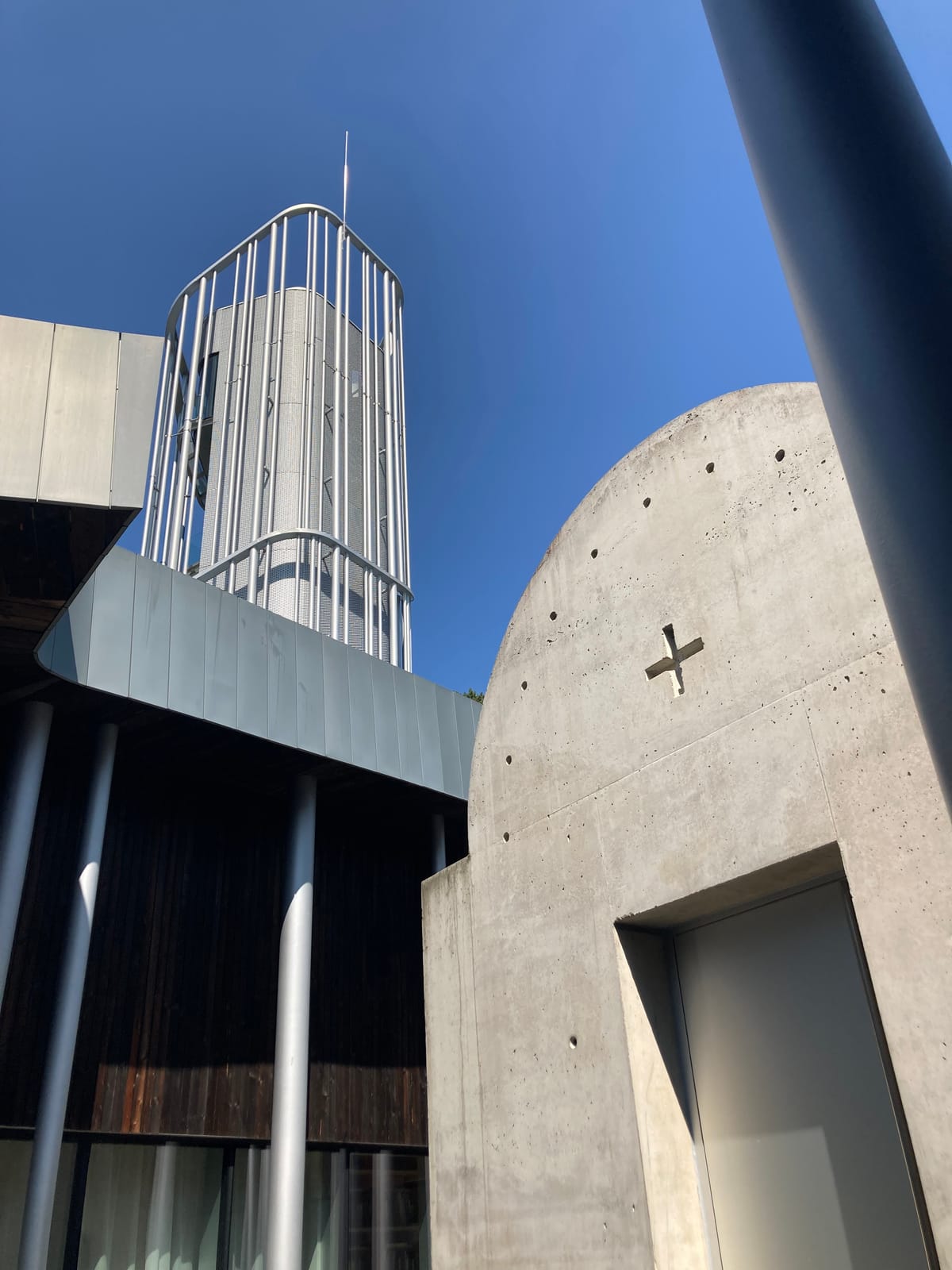
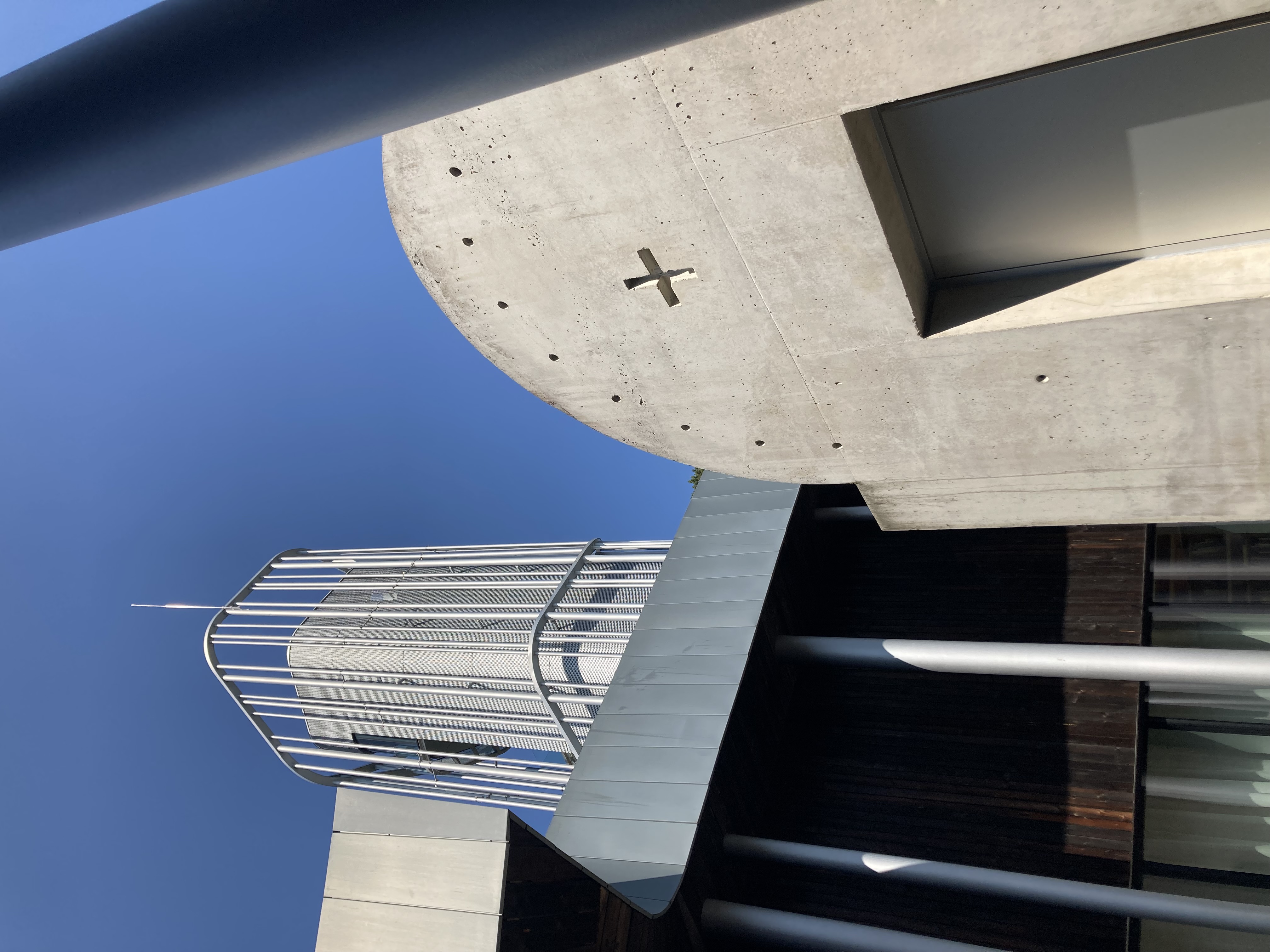
The building has a number of interior courtyards which, while planted, don’t have tree cover in the same way as round the outside of the building so the light gleamed into the spaces unfiltered and fell surprisingly bright after the more subdued interior. In the largest of these, we found some bells (Pärt’s compositional approach is given the name tintinnabuli, or little bells) and the tiniest chapel I’ve ever come across, built in the Greek Orthodox Christian tradition. Pärt’s conversion to Orthodox Christianity was what caused his eventual departure from Estonia and is also the driver and very soul of his work.
If you ask me what it is that Aileen and I both love about Pärt’s work, and why we both understood immediately that building a holiday around a pilgrimage to this lovely place was a banger of a plan, I would have to be honest and tell you that we never actually talked about that. Aileen suggested it, it made absolute sense to me and I also knew that she was the utterly correct person to take the trip with. And I still don’t know what it is that she loves about the music.
I can only speak for me and tell you that in both that lovely centre, and in Arvo Pärt’s music, I meet yet again the life lesson that I’m continuing to grapple with - to slow down, and explore what silence brings to light.
Pärt’s music often sounds simple - this is deceptive, as playing so simply is ferociously difficult. It cycles around very concentrated musical ideas and builds upon those to create work of great scale and work of great intimacy. I find the simplicity of the approach calming, compelling and even a little hypnotic - I absolutely love it. This is music that does what it needs to, in its own time, and I am more than content to go at its speed and see where I am led.
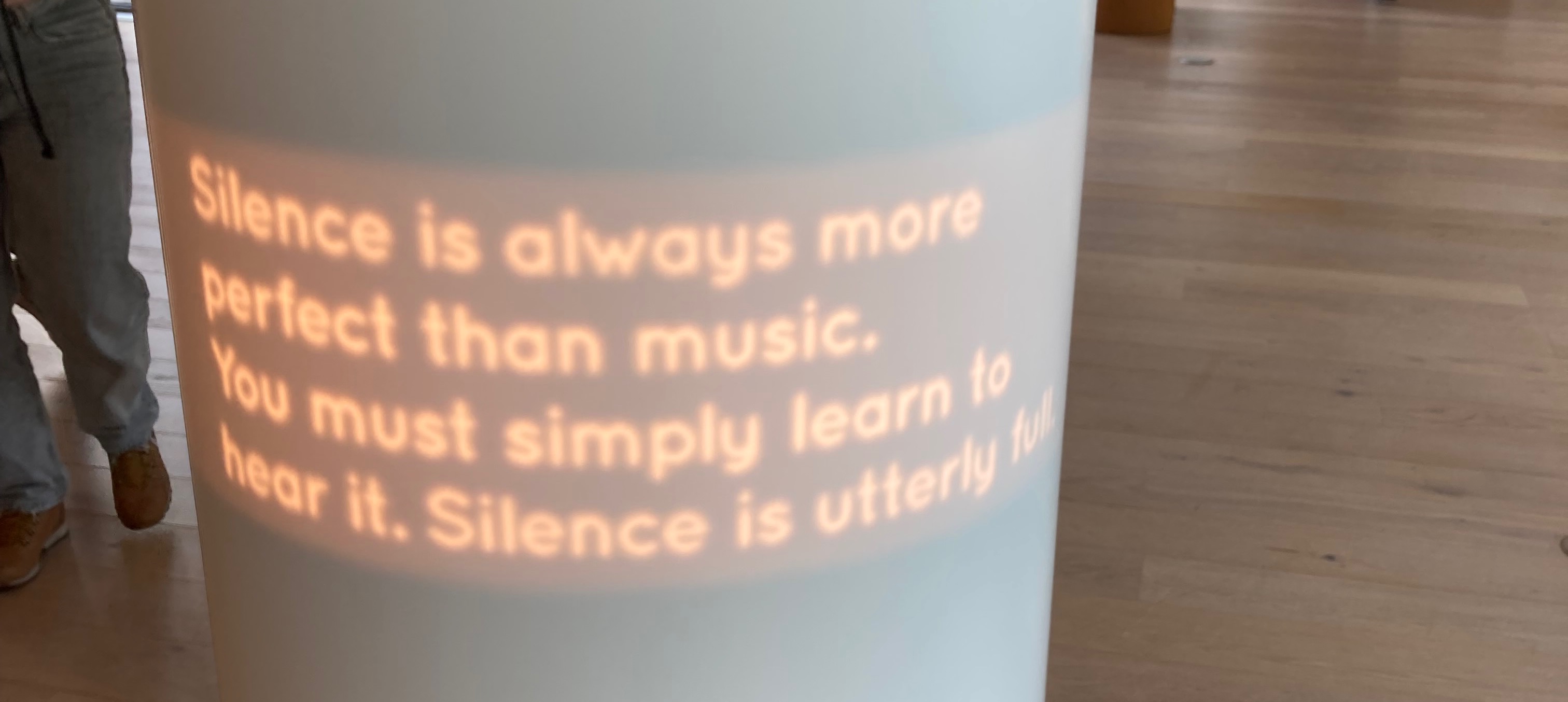
And as I’ve been discovering in other aspects of life, slowing down often goes hand in hand with silence. Lots of music uses silence for dramatic effect; the momentum keeps going, despite the absence of sound. But in Pärt’s music, the silence is more integral and more profound. Silence is part of his musical philosophy - it is the fertile blank canvass on which music is applied, it is something to make us feel awe, and at its deepest, we should be able to find silence within our own souls.
“The silence of our soul, which isn’t even affected by external distractions, is actually more crucial but more difficult to achieve” Arvo Pärt
Something to inspire creativity, something to make us aware of something more, something to make us aware of ourselves. That’s quite the offer (one that can be as spiritual as you like) and the silence Pärt creates in his work is designed to give us space to find those things for ourselves. What an incredible gift to the listener.
Despite the regularity with which this exhortation to slow down and feel at peace in silence seems to be repeated to me, it doesn’t come easy. I think that it’s a combination of so much in today’s world needing immediate response so the pressure is always on to react, and more personally, a life that has long been lived on eggshells and in ‘flight or fight’ mode, which demands you do as much as you can, as quickly as you can, to stay secure and maintain the status quo. But I can see the value of slowing down and in the space that opens up, give room for curiosity, for more measured thinking, for focussed attention - indeed, for stilling and listening to my soul. That sounds a much more appealing, interesting and full way to live and is surely worth pursuing.
Epilogue: A couple of days after coming back from holiday, I was at a do for my choir’s 150th anniversary and was chatting to our Chorus Director James Grossmith. I was telling him about the holiday and this specific trip and he said that he had been thinking about programming Pärt’s Berlinner Messe for the choir in 2025/26. Did I know it? I did not, but immediately seized on it as listening homework and reader, I’m now a little obsessed. I do hope we do sing it; if not this coming season, then soon. New choir goals…
*aside from Long Drink, one of my other favourite things from our trip was the very sticky buns that seemed to work equally well for breakfast or the Swedish institution of ‘fika’, and I was particularly enamoured of the cardamom version. As luck would have it, a recent piece on Will Reidie’s substack The Recovering Line Cook will introduce you to both the concept of fika and a recipe for cardamom buns. Given the mess I make in the kitchen when I bake, I’m not sure whether this will be a calm, slow, meditative task, but I’m definitely feeling the urge to get some on the go.
Thanks for reading What Happens with Music! Subscribe for free to receive new posts and support my work.